Messages
Write the sentence shown for each report, with placeholders for the item's values and plural forms.
The Message of a check is the sentence the panel shows for each item it reports. A good message names the item and gives the measured value and the limit, so it explains itself:
Clip "A002.mov" on V1 plays at 3× speed (maximum 1.5×).
Placeholders
A word in braces is a placeholder: {clip.name} is replaced by the name of the reported clip, {options.maxSpeed} by the option's value. Any field of the check's scope and any option can be a placeholder.
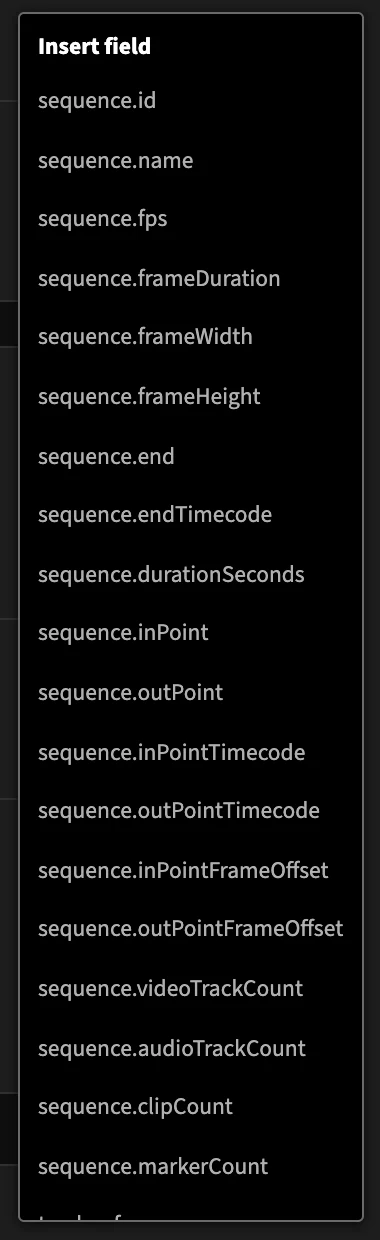
The button at the right of the message lists them all, and adds the one you pick at the end of the text. You can also type them; the editor reports a placeholder that names no field.
How values are shown:
| Value | Shown as |
|---|---|
| text | as it is: A002.mov |
| number | formatted for the panel's language, with at most one decimal: 12.5, 12,5 in French |
| yes/no | true or false |
| no value | ? |
{clip.speed:3} shows up to three decimals instead of one.
Times are numbers of ticks, which mean nothing to a reader: show the timecode fields instead, such as {clip.startTimecode} or {marker.startTimecode}.
To show a value as words that depend on the language, such as a marker type, use a label.
Plural forms
"1 frames long" reads badly. When a number in the sentence changes its grammar, tick Plural forms: the message becomes one sentence per form, and a Count field picks the form from a number.
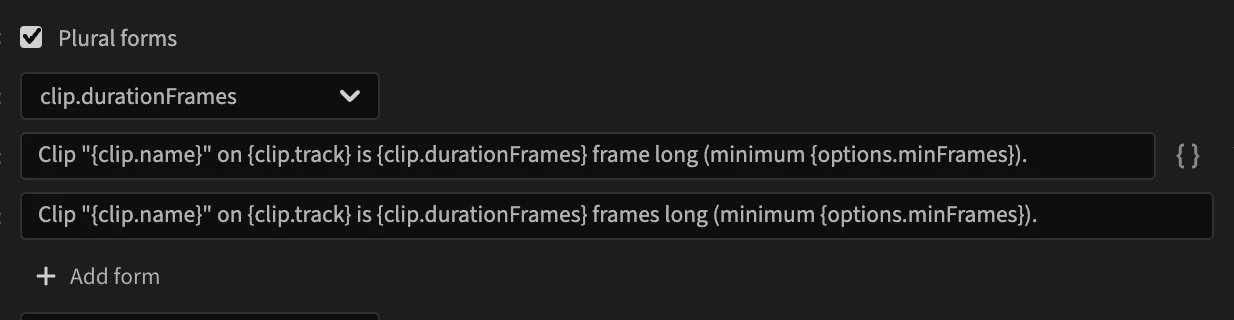
- Count field: the number that decides the form, here
clip.durationFrames. - One: the sentence for one (1 frame).
- Other: the sentence for every other number. It is required.
- Add form adds Few or Many, for languages that have them, such as Russian.
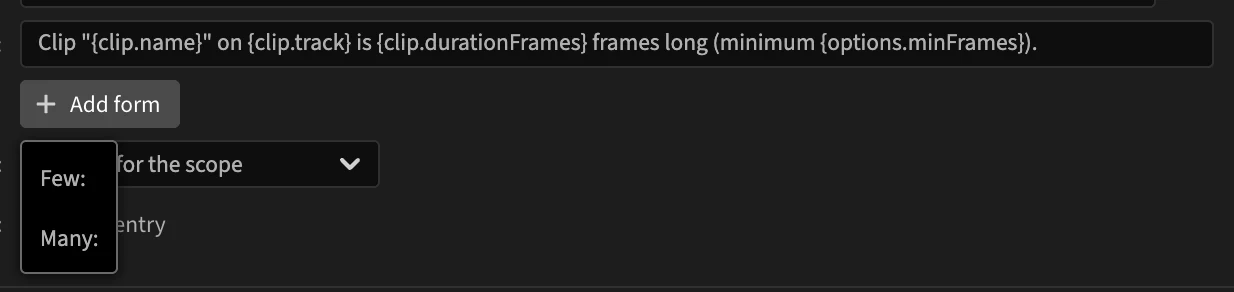
Write the whole sentence in each form. Unticking Plural forms keeps the Other sentence as the message.
Messages and languages
The message is edited in the panel's language, like the name and description. Other languages keep their own text, or show the English one until they have it. See Translations.
In a rule file
The message is the message of a check: a string, or an object keyed by language; plural forms are { "count", "one", "other" }. See Messages.